Khadi Boli, also known as Kauravi—and sometimes referred to as Khari Boli or Khāri Boli—is the language spoken across Harit Pradesh (Western Uttar Pradesh) and parts of Uttarakhand, Delhi, and Haryana.
Khadi Boli may also be called Khadi, Khadi Bhasha, or Kauravi. It is a language of strong, grounded sounds—sounds that can feel intense to some ears. The most authentic pronunciation is Khadi Bolli (खड़ी बोल्ली), but for simplicity, I will use the term Khadi Boli throughout.
Since this is my native language, let me offer you a small taste of this vibrant, earthy tongue through a few everyday Khadi Boli words (Khadi Boli ke shabd).
कट्टो (Katto): प्रेयसी | Beloved
किसी के पिच्छै कुत्ते छोड़ना (Kisi ke pichhe kuttey chhodna): किसी को बिना बात परेशान करना (ईर्ष्यावश (जलन अथवा किलस)) के कारण | To trouble someone without any valid reason (out of jealousy)
- यो शब्द नू बोल्ला जा
सेळक (Selak): शीतलता | Coolness
संक्कळ, सांक्कळ (Sankal, Saankal): द्वार को बंद रखने हेतु ज़ंजीर अथवा चिटकनी | Chain or bolt for keeping the door locked
- यो शब्द नू बोल्ला जा
धूळिया-धुम्माड (Dhooliya dhummād): धूल और धुँआ | Dust and smoke
Now that you have a feel for how Khadi Boli sounds, let’s briefly look at its syntax and how it differs from everyday, standard Hindi.
In Khadi Boli, the consonant “ण” is often used instead of “न.” For example, water is spoken as पाणी, not पानी.
If I were to ask who is inside a room, I might say:
“अरै, कौण है इस कमरे मैं?” or “अरै, कूण है इस कमरे मैं?”
instead of the standard Hindi:
“अरे, कौन है इस कमरे में?”
Similarly, an uncle is addressed as चाच्चा, not चाचा.
There is also an interesting observation connected to the name itself. The word Khadi means “standing.” In that sense, Khadi Boli—or Khadi Bhasha—can be understood as a “standing language,” one that requires firmness and effort in pronunciation. This gives the language its characteristic rustic, grounded quality.
Khadi Boli aka Khāri Boli
Khadi Boli is sometimes referred to as Khāri Boli. The word Khāri comes from Khār, meaning salt. Metaphorically, this lends the language a certain “saltiness”—a sharp, direct edge that sets it apart.
This quality distinguishes Khāri Boli from dialects such as Braj Bhasha and Awadhi, traditionally spoken in regions like Mathura and Ayodhya, and often described as sweeter in tone. Because of this contrast, those dialects are occasionally called Meethi Boli, while Khadi Boli stands firm in its earthy directness.
It’s worth noting that the term Khāri Boli is not commonly used today and usually appears only in comparative or academic discussions. Another term you may encounter is Khari Bolli (खरी बोल्ली), meaning pure language. This reflects the view that Khadi Boli represents the most unadulterated form of Hindi—the source from which standard Hindi and Urdu later evolved. The name Kauravi is also used for this language.
Kauravi (कौरवी)
It is believed that the Kauravas—the sons of King Dhritarashtra and Queen Gandhari—spoke this language during the era of the Mahabharata. This association is what led to the name Kauravi.
Many places linked to the Mahabharata—such as Hastinapur, Parikshitgarh, Shukratal, Barnava, and Indraprastha (present‑day Delhi)—are located in or around today’s Western Uttar Pradesh.
Interestingly, actor Gajendra Chauhan, who played Yudhishthir in B.R. Chopra’s Mahabharata, is himself a native Khadi Boli speaker.
The infamous Lakshagrih—the structure made of lākh where the Kauravas conspired to burn the Pandavas—still stands in Barnava (Baraut, Baghpat). Today, it houses a Sanskrit Vidyapeeth.
An Important Thing to Remember
The terms Khāri Boli, Khari Boli, and Kauravi do exist, though they are rarely used. Their rarity often leads people to believe that Khadi Boli is the only valid name. Rarity, however, does not imply non‑existence. These terms may not be popular, but they are historically grounded and linguistically meaningful.
To summarize: the most commonly used and widely recognized name for the language of Western Uttar Pradesh is Khadi Boli.
You can get a sense of how Kauravi (Khadi Boli) sounds by watching the linked video clip.
Are Khadi Boli and Haryanvi the Same?
Many people assume Khadi Boli and Haryanvi are the same language. They are not.
Some regions of Haryana do speak Khadi Boli, largely due to geographical overlap with Western Uttar Pradesh. For example, Bahalgarh in Sonipat borders Baghpat district, and the language spoken there often blends features of both Khadi Boli and Haryanvi.
“तू मेरी गैल घर चल।” (Khadi Boli)
“तू मेरी गैल्याँ घराँ चाल।” (Haryanvi)
While there are similarities in structure and tone, the two remain distinct.
Where Khadi Boli Is Spoken
Khadi Boli is spoken primarily across Western Uttar Pradesh, including:
Meerut, Modinagar, Muradnagar, Muzaffarnagar, Saharanpur, Shamli, Baraut, Baghpat, Ghaziabad, Bijnor, Gautam Buddh Nagar (Noida), Hapur, and parts of Bulandshahar.
The language changes subtly from region to region. The Khadi Boli of Saharanpur sounds different from that of Baghpat, and Muzaffarnagar has its own tonal flavor. These variations only add to the richness of the language.
A Key Linguistic Fact
Modern standard Hindi and Urdu both evolved from Khadi Boli. Simply put:
Khadi Boli is the mother of Hindi and Urdu.
As noted by Vimlesh Kanti Verma:
“मुग़लों के भारत आने पर सैनिक शिविरों में भारतीय व्यापारियों तथा मुग़ल सैनिक ख़रीददारों के बीच जिस भाषा का विकास हुआ, वह भाषा संरचना की दृष्टि से खड़ीबोली थी तथा उसके शब्द‑भंडार में फ़ारसी‑अरबी शब्द भी थे।” (हिंदी और उसकी उपभाषाएँ – एक संक्षिप्त सर्वतोमुखी सर्वेक्षण, पृष्ठ संख्या – १४)
Why I Started Khadi Boli Shabdkosh
In 2010, while conducting personality development classes at Subharti University in Meerut, I noticed something unsettling. Many students felt uncomfortable—sometimes even embarrassed—about speaking Khadi Boli.
Some viewed it as uncivilized or inappropriate. To avoid judgment, they hid their linguistic identity. Over time, this distance from one’s mother tongue takes a quiet but real toll.
Your self‑image is deeply connected to your roots. It is difficult to fully accept yourself while rejecting your own language.
As Bhartendu Harishchandra wrote:
“निज भाषा उन्नति अहै, सब भाषा को मूल । बिन निज भाषा ज्ञान के मिटे न हिय को शूल ।।”
(The progress of one’s language is the key to all development. Without the proper knowledge of one’s mother tongue, one cannot feel expressed.)
Over time, this led me to question the very idea of “saving” a language.
Khadi Boli doesn’t need to be saved. It needs to be spoken—steadily, honestly, and without self-doubt.
This space exists to make that speaking easier—naturally, and at one’s own pace.
Respect Your Language
Respecting your mother tongue is not about rejecting other languages. It is about honoring where you come from. Letting go of your language does not make you more cultured—it only distances you from your roots.
If you are still learning Khadi Boli, take your time. With regular practice, it will come. The willingness is already there; what has long been missing are reliable places to learn from.
For years, there has been an astonishing amount of misinformation around Khadi Boli. Like many others, I tried searching for it online and found very little—no authentic documentation, no serious articles, not even a dedicated blog post that treated the language with care and accuracy.
This very lack of authentic resources led me to create Khadi Boli Shabdkosh.
Khadi Boli Shabdkosh: A Living Resource
On 15th September 2011, I started an article on Khadi Boli on my personal development blog—AvdheshTondak.com. That article was a collection of day-to-day Khadi Boli words. Here’s how it looked:

What began in 2011 as a small article on my personal blog gradually grew into something much larger. On 5 November 2019, KhadiBoliShabdkosh.com was born.
Today, it stands as the first and only dedicated online collection of original Khadi Boli words—freely available, for everyone.
The response has been deeply encouraging. Messages from readers and learners remind me why this work matters.
“Thank you so much. Aap bhot accha kaam kar rahe ho hamari sanskriti ko badhane k liye. Though I belong to Hapur. But I was raised in different parts of mp and chattisgarh because of my father’s job and my parents did not teach me khadi boli because they thought it’s uncivilised (I am very proud of my culture and mother tongue and would like to teach my kids). And I did not speak my mother tongue (and it hurt me alot that I don’t speak my mother tongue) until I start to learn online. Your blog and channel helped me a lot. Thanks alot please upload some other videos too, and keep the good work on.”
And I also received some emails:

I am a resident of somewhere between Meerut and East Delhi. Somehow, my roots are linked in somewhere middle of Meerut and Delhi and I have always lived in that stereotype urban atmosphere with English as my first language although I have developed that modern version of Hindi nicely recently but never focused too much on khadi boli. Sometimes just for fun, I will speak in that accent although I don’t have khadi vocabulary yet but I have the accent. I realized its somehow naturally implanted in me and I actually feel expressed better when spoken words like fuhad challe dharti hile, manne na pata, lool, lullu and such words really do make me feel good but I just thought its not that formal and suitable for me to speak khadi boli with everyone because I’ve been dealing with people from different accents and some East UP People like Banaras aur Kanpur side consider this type of accent quite disrespectful. For them tum is respectful they never address as tu and main so you know influence of surroundings but I have that accent and that line that our language is salty as it is supposed to be . Man it blew my mind off. Thank you so much for this. I was never ashamed but I just thought it to be less formal but I don’t need to speak it entirely in its pure form with everyone but can definitely adapt the accent permanently and guess what all thanks to you. Thank you so much and I have a request this is my personal ID so please don’t share this with anyone or on some public platform you can blur m ID and then show the message content anywhere you wish.
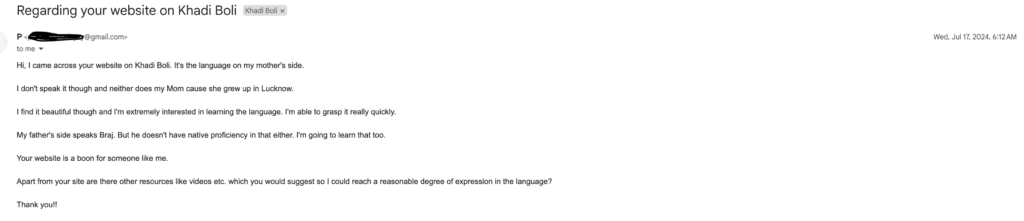
Hi, I came across your website on Khadi Boli. It’s the language on my mother’s side.
I don’t speak it though and neither does my Mom cause she grew up in Lucknow.I find it beautiful though and I’m extremely interested in learning the language. I’m able to grasp it really quickly.My father’s side speaks Braj. But he doesn’t have native proficiency in that either. I’m going to learn that too.Your website is a boon for someone like me.Apart from your site are there other resources like videos etc. which you would suggest so I could reach a reasonable degree of expression in the language?Thank you!!

Good evening sir, I would like to start out by saying that you’re doing a fabulous job in trying to preserve a near extinct dialect. Me being a 21 year old college student have always had affection towards our mother tongue but sadly, being a city jock I never really got a very good hold of it and now, because of you, I have an opportunity to be fluent in our graceful and rustic jatu or khadi boli.
Coming to the point, I wanted to give you a suggestion to help learners like me get better in the said dialect.– In your website you have taken a Hindi letter and provided us with all the available khari words with their meanings.– Just kindly make sure to write a few sentences using that particular khadi word so that kids like me could learn to use the term in the right sentence in a right manner.– It would also help us learn the flow of the language.Thank you for your time.
How to Use this Shabdkosh
Explore words alphabetically using the links. Meanings are provided in Hindi and English wherever possible, along with audio samples for pronunciation.
Khadi Boli is a living, expressive language. Enjoy exploring it—and return whenever you need a reference.
You are always welcome here.
This Shabdkosh grew out of a longer personal journey—one that includes questions of language, identity, and the quiet shame many of us are taught to carry about the way we speak. I’ve written more openly about that journey on my personal site, including why Khadi Boli is so often misunderstood.